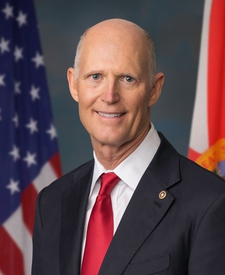
U.S. Senate · Florida
Sen. Rick Scott
Where they sit
Seated by voting record in the Senate. Percentiles run from 0 (most liberal) to 100 (most conservative).
Rick Scott's seat is marked. Seats run from most liberal (left) to most conservative (right). Color shows how often each member crosses party lines toward the middle on votes that divide the parties: solid blue or red means almost never, and purple means on at least 1 in 10 of those votes. Gray seats are members too new to score. How this is measured
This score measures who votes with whom. A member who votes no because a bill goes too far, or not far enough, can look more moderate than their views.
With their party and with the President
How this is measured →Lower than 28 of 53 Senate Republicans.
Expected is the typical score for senators of the same party whose states voted like this one for president in 2024.
Each line is one Senate member, grouped by party. The dot is Rick Scott. The dark line is what we'd expect given how this state voted for president in 2024.
How this is measuredLower than 46 of 53 Senate Republicans.
Expected is the typical score for senators of the same party whose states voted like this one for president in 2024.
Each line is one Senate member, grouped by party. The dot is Rick Scott. The dark line is what we'd expect given how this state voted for president in 2024.
How this is measuredWhere they broke ranks
Votes where Rick Scott went against most of their party or against the President's stated position.
Every vote
Every roll call in the Senate this Congress, with how Rick Scott voted, how their party voted and the President's position.
| Date | Vote | Their vote | Most of their party | President wanted | Result |
|---|---|---|---|---|---|
| Loading… | |||||
A dash means the parties didn't split on that vote, or the President took no public position before it. “Party-line” and “President took a position” list exactly the votes each score counts: the ones cast Yes or No. Missed votes don't count either way and are under “Missed”.
Votes most like
Rick Scott and Ashley Moody voted the same way on 98% of votes.
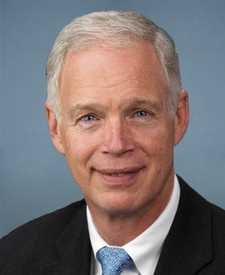 Sen. Ron Johnson
Voted the same way 99% of the time
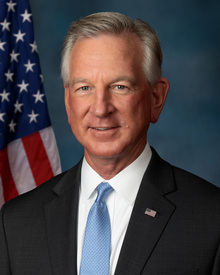 Sen. Tommy Tuberville
Voted the same way 98% of the time
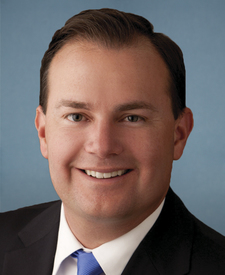 Sen. Mike Lee
Voted the same way 98% of the time
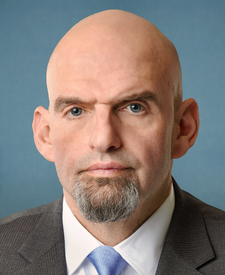 Sen. John Fetterman
Closest member of the other party · Voted the same way 24% of the time
Florida
Florida's delegation →How Florida voted for president in 2024
Contact
- Phone
- 202-224-5274
- Office
- 110 Hart Senate Office Building Washington DC 20510
- Contact form
- www.rickscott.senate.gov
Issue by issue
How often Rick Scott votes with their party, and with the President, on each kind of issue. Issues are the policy areas Congress assigns to each bill. "With their party" counts only votes where most Democrats and most Republicans voted on opposite sides; "With the President" counts only votes where he took a public position first.
Rick Scott sides with their party least often on Armed Forces and National Security (90%).
Fewer than 5 party-line votes, so not charted: Sports and Recreation (4 votes), Health (4 votes), Emergency Management (2 votes), Science, Technology, Communications (2 votes), Education (2 votes), Crime and Law Enforcement (1 vote), Families (1 vote).
Rick Scott votes with the President least often on Economics and Public Finance (82%).
Fewer than 5 votes where the President took a position, so not charted: Finance and Financial Sector (4 votes), Government Operations and Politics (3 votes), Sports and Recreation (3 votes), Taxation (2 votes), Emergency Management (2 votes), Immigration (1 vote), Science, Technology, Communications (1 vote), Crime and Law Enforcement (1 vote), Housing and Community Development (1 vote).
Bipartisan bills led
0 passed their chamber · 0 became law
-
S. 5297 · American Pharmaceutical Security ActCo-lead · Introduced Aug. 6, 2026 · HealthIntroduced
-
S. 5016 · Clean Water Allotment Modernization Act of 2026Sponsor · Introduced July 16, 2026 · Environmental ProtectionIntroduced
-
S. 4987 · Pharmaceutical Investment Oversight and Accountability ActCo-lead · Introduced July 15, 2026 · HealthIntroduced
-
S. 4901 · Preventing Crimes Against Veterans Act of 2026Co-lead · Introduced June 24, 2026 · Crime and Law EnforcementIntroduced
-
S. 4916 · Aging with Artificial Intelligence Act of 2026Co-lead · Introduced June 24, 2026 · HealthIntroduced
-
S. 4782 · ReportScams.gov ActCo-lead · Introduced June 15, 2026 · Government Operations and PoliticsIntroduced
-
S. 4564 · Maritime Cybersecurity ActSponsor · Introduced May 19, 2026 · Transportation and Public WorksIntroduced
-
S. 4524 · BLAST ActSponsor · Introduced May 13, 2026 · Crime and Law EnforcementIntroduced
-
S. 4432 · Tibet Atrocities Determination ActSponsor · Introduced April 29, 2026 · International AffairsIntroduced
-
S. 3788 · CLEAR LABELS ActSponsor · Introduced Feb. 5, 2026 · HealthIntroduced
-
S. 3588 · School Access to Naloxone Act of 2026Co-lead · Introduced Jan. 7, 2026 · HealthIntroduced
-
S. 3562 · Disclosing Investments in Foreign Adversaries Act of 2025Sponsor · Introduced Dec. 18, 2025 · Finance and Financial SectorIntroduced
-
S. 3355 · National Strategy for Combating Scams Act of 2025Co-lead · Introduced Dec. 4, 2025 · CommerceIntroduced
-
S. 3295 · A bill to amend the Internal Revenue Code of 1986 to establish a credit for adult child caregivers.Co-lead · Introduced Dec. 2, 2025 · TaxationIntroduced
-
S. 3200 · License Monopoly Prevention Act of 2025Sponsor · Introduced Nov. 19, 2025 · Foreign Trade and International FinanceIntroduced
-
S. 2541 · Food Date Labeling Act of 2025Co-lead · Introduced July 30, 2025 · HealthIntroduced
-
S. 2406 · Canadian Snowbirds Act of 2025Sponsor · Introduced July 23, 2025 · ImmigrationIntroduced
-
S. 2353 · Microplastics Safety ActCo-lead · Introduced July 17, 2025 · HealthIntroduced
-
S. 2314 · SHARKED Act of 2025Sponsor · Introduced July 16, 2025 · Public Lands and Natural ResourcesIntroduced
-
S. 2177 · No Adversarial AI ActSponsor · Introduced June 25, 2025 · Government Operations and PoliticsIntroduced
-
S. 2065 · CHECKPOINT ActSponsor · Introduced June 12, 2025 · ImmigrationIntroduced
-
S. 1854 · Haiti Criminal Collusion Transparency Act of 2025Co-lead · Introduced May 21, 2025 · International AffairsIntroduced
-
S. 1802 · CARGO Act of 2025Sponsor · Introduced May 19, 2025 · HealthIntroduced
-
S. 1685 · No Funds for Forced Labor ActSponsor · Introduced May 8, 2025 · International AffairsIntroduced
-
S. 1627 · A bill to require Presidential appointment and Senate confirmation of the Inspector General of the Board of Governors of the Federal Reserve System and the Bureau of Consumer Financial Protection.Sponsor · Introduced May 6, 2025 · Finance and Financial SectorIntroduced
-
S. 1550 · Improving SCRA Benefit Utilization Act of 2025Co-lead · Introduced May 1, 2025 · Armed Forces and National SecurityIntroduced
-
S. 1455 · A bill to establish new ZIP Codes for certain communities, and for other purposes.Sponsor · Introduced April 10, 2025 · Government Operations and PoliticsIntroduced
-
S. 812 · A bill to direct the Secretary of Veterans Affairs to ensure veterans may obtain a physical copy of a form for reimbursement of certain travel expenses by mail or at medical facilities of the Department of Veterans Affairs, and for other purposes.Sponsor · Introduced March 3, 2025 · Armed Forces and National SecurityIntroduced
-
S. 626 · SOCIAL MEDIA ActSponsor · Introduced Feb. 19, 2025 · Crime and Law EnforcementIntroduced
-
S. 617 · OPIOIDS ActSponsor · Introduced Feb. 18, 2025 · Crime and Law EnforcementIntroduced
-
S. 548 · Caribbean Border Counternarcotics Strategy ActSponsor · Introduced Feb. 12, 2025 · Crime and Law EnforcementIntroduced
-
S. 450 · Decoupling from Foreign Adversarial Battery Dependence ActSponsor · Introduced Feb. 6, 2025 · Foreign Trade and International FinanceIntroduced
-
S. 473 · SENIOR ActSponsor · Introduced Feb. 6, 2025 · HealthIntroduced
-
S. 294 · COOL Online ActCo-lead · Introduced Jan. 29, 2025 · Agriculture and FoodIntroduced
-
S. 221 · Extending Limits of United States Customs Waters Act of 2025Sponsor · Introduced Jan. 23, 2025 · Foreign Trade and International FinanceIntroduced
-
S. 88 · No Budget, No Pay ActSponsor · Introduced Jan. 14, 2025 · CongressIntroduced
-
S. 29 · Sunshine Protection Act of 2025Sponsor · Introduced Jan. 7, 2025 · Science, Technology, CommunicationsIntroduced
Votes: Voteview (UCLA). Bills: Congress.gov. President's positions: our public list. 2024 results by district: The Downballot. How this is measured · Corrections