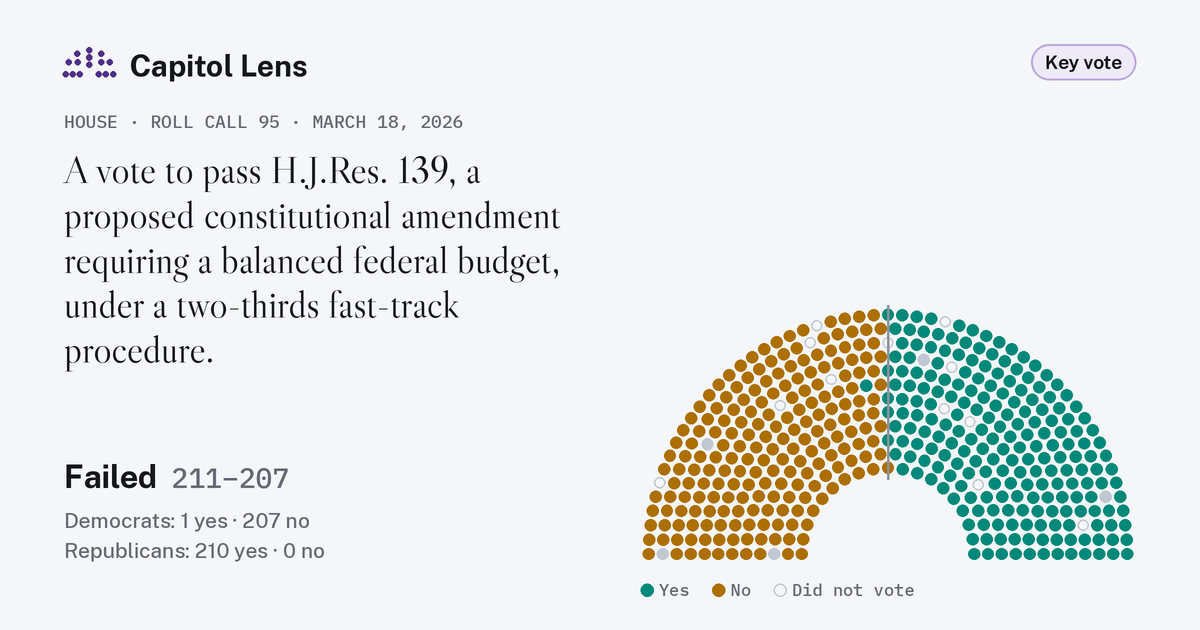
Proposing an amendment to the Constitution of the United… (H.J.Res. 139) · House · Roll call 95 · 2nd session · March 18, 2026 A vote to pass H.J.Res. 139, a proposed constitutional amendment requiring a balanced federal budget, under a two-thirds fast-track procedure.
Why it matters: H.J.Res. 139 would have proposed a constitutional amendment barring total federal spending in a year from exceeding the average federal revenue of the three prior years, adjusted for population and inflation. Drafted and checked with AI
How did your own members vote? Find them by address or ZIP code
- Question
- On Motion to Suspend the Rules and Pass
- Official record
- House roll call 95, 119th Congress, 2nd session
- Capitol Lens ID
- h455, used in this page's address. It numbers every House roll call of the 119th Congress in order, so it differs from the official number, which restarts each session.
- Bill
- H.J.Res. 139, Proposing an amendment to the Constitution of the United States requiring a balanced budget for the Federal Government.
How each party voted
Most Democrats voted No (207 of 214).
Most Republicans voted Yes (210 of 218).
Party-line vote: most Democrats and most Republicans voted on opposite sides.
About this vote
H.J.Res. 139 proposes a constitutional amendment that would bar total federal spending in a year from exceeding the average yearly federal revenue of the three prior years, adjusted for changes in population and inflation. Suspending the rules is a fast-track procedure that limits debate and requires a two-thirds vote to pass. A proposed constitutional amendment also needs two-thirds of both chambers before it goes to the states. The measure fell short of the two-thirds needed, so it did not pass.
This summary was drafted and checked with AI (Claude) using only the official record of the vote. Report an error
Summary by the Congressional Research Service
This joint resolution proposes a constitutional amendment prohibiting total federal expenditures for a year from exceeding the average annual federal receipts collected in the three prior years, adjusted for changes in the population of U.S. citizens and inflation.