U.S. Senate · Kentucky
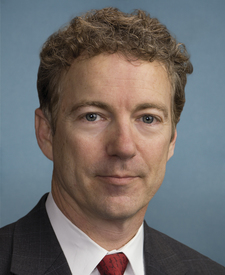
Sen. Rand Paul
Where they sit
Seated by voting record in the Senate. Percentiles run from 0 (most liberal) to 100 (most conservative).
Rand Paul's seat is marked. Seats run from most liberal (left) to most conservative (right). Color shows how often each member crosses party lines toward the middle on votes that divide the parties: solid blue or red means almost never, and purple means on at least 1 in 10 of those votes. Gray seats are members too new to score. How this is measured
This score measures who votes with whom. A member who votes no because a bill goes too far, or not far enough, can look more moderate than their views.
With their party and with the President
How this is measured →Lower than 50 of 53 Senate Republicans.
Expected is the typical score for senators of the same party whose states voted like this one for president in 2024.
Each line is one Senate member, grouped by party. The dot is Rand Paul. The dark line is what we'd expect given how this state voted for president in 2024.
How this is measuredLowest of all 53 Senate Republicans.
Expected is the typical score for senators of the same party whose states voted like this one for president in 2024.
Each line is one Senate member, grouped by party. The dot is Rand Paul. The dark line is what we'd expect given how this state voted for president in 2024.
How this is measuredWhere they broke ranks
Votes where Rand Paul went against most of their party or against the President's stated position.
-
Sept. 29, 2026
S911Voted Yes -
Sept. 28, 2026
S909Voted No -
Sept. 24, 2026
S903Voted Yes -
Sept. 15, 2026
S894Voted No -
Aug. 8, 2026
S887Voted No -
Aug. 7, 2026
S883Voted No -
Aug. 7, 2026
S882Voted Yes -
July 30, 2026
S875Voted Yes -
July 16, 2026
S857Voted No -
June 23, 2026
S843Voted Yes -
June 16, 2026
S833Voted Yes -
June 5, 2026
S823Voted No -
May 19, 2026
S788Voted Yes -
May 13, 2026
S777Voted Yes -
April 30, 2026
S772Voted Yes -
April 28, 2026
S767Voted No -
April 23, 2026
S764Voted No -
April 22, 2026
S747Voted Yes -
April 15, 2026
S738Voted Yes -
March 24, 2026
S728Voted Yes -
March 23, 2026
S722Voted No -
March 18, 2026
S717Voted Yes -
March 12, 2026
S712Voted No -
March 4, 2026
S705Voted Yes -
Jan. 30, 2026
S679Voted No -
Jan. 29, 2026
S672Voted No -
Jan. 15, 2026
S670Voted No -
Jan. 14, 2026
S668Voted No -
Jan. 8, 2026
S664Voted Yes -
Jan. 6, 2026
S662Voted No -
Dec. 18, 2025
S659Voted No -
Dec. 11, 2025
S643Voted No -
Nov. 10, 2025
S618Voted No -
Nov. 10, 2025
S617Voted No -
Nov. 10, 2025
S616Voted No -
Nov. 10, 2025
S615Voted No -
Nov. 10, 2025
S611Voted No -
Nov. 9, 2025
S610Voted No -
Nov. 6, 2025
S608Voted Yes -
Nov. 5, 2025
S607Voted No -
Nov. 5, 2025
S606Voted No -
Nov. 4, 2025
S603Voted No -
Oct. 30, 2025
S600Voted Yes -
Oct. 29, 2025
S598Voted Yes -
Oct. 28, 2025
S594Voted Yes -
Oct. 28, 2025
S590Voted No -
Oct. 22, 2025
S581Voted No -
Oct. 20, 2025
S576Voted No -
Oct. 16, 2025
S573Voted No -
Oct. 15, 2025
S572Voted No -
Oct. 14, 2025
S571Voted No -
Oct. 9, 2025
S569Voted Yes -
Oct. 9, 2025
S558Voted No -
Oct. 8, 2025
S555Voted Yes -
Oct. 8, 2025
S551Voted No -
Oct. 6, 2025
S545Voted No -
Oct. 3, 2025
S543Voted No -
Oct. 1, 2025
S537Voted No -
Sept. 30, 2025
S535Voted No -
Sept. 29, 2025
S533Voted No -
Sept. 29, 2025
S532Voted No -
Sept. 29, 2025
S531Voted No -
Sept. 19, 2025
S530Voted No -
Sept. 19, 2025
S529Voted No -
Sept. 19, 2025
S528Voted No -
Sept. 10, 2025
S512Voted No -
July 17, 2025
S410Voted No -
July 1, 2025
S372Voted No -
July 1, 2025
S371Voted No -
July 1, 2025
S370Voted No -
July 1, 2025
S369Voted Yes -
July 1, 2025
S368Voted Yes -
June 30, 2025
S352Voted Yes -
June 28, 2025
S329Voted No -
June 27, 2025
S328Voted Yes -
June 25, 2025
S325Voted No -
June 24, 2025
S324Voted No -
June 17, 2025
S318Voted No -
June 12, 2025
S312Voted No -
June 12, 2025
S311Voted No -
June 12, 2025
S310Voted No -
June 12, 2025
S309Voted Yes -
June 11, 2025
S305Voted No -
May 21, 2025
S263Voted No -
May 19, 2025
S262Voted No -
May 8, 2025
S240Voted No -
April 30, 2025
S226Voted No -
April 30, 2025
S225Voted Yes -
April 5, 2025
S191Voted No -
April 3, 2025
S169Voted No -
April 2, 2025
S160Voted Yes -
March 14, 2025
S133Voted No -
March 14, 2025
S128Voted No -
March 11, 2025
S115Voted No -
March 11, 2025
S113Voted No -
March 11, 2025
S112Voted No -
March 10, 2025
S111Voted No -
March 6, 2025
S109Voted No -
Feb. 26, 2025
S94Voted No -
Feb. 21, 2025
S87Voted No -
Feb. 18, 2025
S58Voted No
Every vote
Every roll call in the Senate this Congress, with how Rand Paul voted, how their party voted and the President's position.
| Date | Vote | Their vote | Most of their party | President wanted | Result |
|---|---|---|---|---|---|
| Loading… | |||||
A dash means the parties didn't split on that vote, or the President took no public position before it. “Party-line” and “President took a position” list exactly the votes each score counts: the ones cast Yes or No. Missed votes don't count either way and are under “Missed”.
Votes most like
Rand Paul and Mitch McConnell voted the same way on 83% of votes.
 Sen. Rick Scott
Voted the same way 88% of the time
 Sen. Ron Johnson
Voted the same way 87% of the time
 Sen. Mike Lee
Voted the same way 86% of the time
 Sen. Jeanne Shaheen
Closest member of the other party · Voted the same way 23% of the time
Kentucky
Kentucky's delegation →How Kentucky voted for president in 2024
Contact
- Phone
- 202-224-4343
- Office
- 295 Russell Senate Office Building Washington DC 20510
- Contact form
- www.paul.senate.gov
Issue by issue
How often Rand Paul votes with their party, and with the President, on each kind of issue. Issues are the policy areas Congress assigns to each bill. "With their party" counts only votes where most Democrats and most Republicans voted on opposite sides; "With the President" counts only votes where he took a public position first.
Rand Paul sides with their party least often on Foreign Trade and International Finance (0%) and International Affairs (26%).
Fewer than 5 party-line votes, so not charted: Sports and Recreation (4 votes), Health (4 votes), Emergency Management (2 votes), Science, Technology, Communications (2 votes), Education (2 votes), Crime and Law Enforcement (1 vote), Families (1 vote).
Rand Paul votes with the President least often on Foreign Trade and International Finance (0%) and Economics and Public Finance (9%).
Fewer than 5 votes where the President took a position, so not charted: Finance and Financial Sector (4 votes), Sports and Recreation (3 votes), Government Operations and Politics (2 votes), Taxation (2 votes), Emergency Management (2 votes), Immigration (1 vote), Science, Technology, Communications (1 vote), Crime and Law Enforcement (1 vote), Housing and Community Development (1 vote).
Bipartisan bills led
3 passed their chamber · 0 became law
-
S.J.Res. 88 · A joint resolution terminating the national emergency declared to impose global tariffs.Co-lead · Introduced Oct. 7, 2025 · Foreign Trade and International FinancePassed one chamber
-
S.J.Res. 81 · A joint resolution terminating the national emergency declared to impose duties on articles imported from Brazil.Co-lead · Introduced Sept. 18, 2025 · Foreign Trade and International FinancePassed one chamber
-
S.J.Res. 77 · A joint resolution terminating the national emergency declared to impose duties on articles imported from Canada.Co-lead · Introduced Sept. 16, 2025 · Foreign Trade and International FinancePassed one chamber
-
S. 4941 · Modernizing Opioid Treatment Access Act 2.0 of 2026Co-lead · Introduced June 24, 2026 · HealthIntroduced
-
S. 4537 · A bill to repeal the Military Selective Service Act.Co-lead · Introduced May 14, 2026 · Armed Forces and National SecurityIntroduced
-
S. 4315 · Hemp Safety Enforcement ActSponsor · Introduced April 16, 2026 · Agriculture and FoodIntroduced
-
S.J.Res. 104 · A joint resolution to direct the removal of United States Armed Forces from hostilities within or against the Islamic Republic of Iran that have not been authorized by Congress.Co-lead · Introduced Jan. 29, 2026 · International AffairsIntroduced
-
S. 3686 · Hemp Planting Predictability ActCo-lead · Introduced Jan. 15, 2026 · Agriculture and FoodIntroduced
-
S. 3440 · Temporary Family Visitation ActSponsor · Introduced Dec. 11, 2025 · ImmigrationIntroduced
-
S. 3414 · Justice for Breonna Taylor ActSponsor · Introduced Dec. 10, 2025 · Crime and Law EnforcementIntroduced
-
S. 3346 · Freedom to Heal Act of 2025Co-lead · Introduced Dec. 4, 2025 · HealthIntroduced
-
S.J.Res. 98 · A joint resolution to direct the removal of United States Armed Forces from hostilities within or against Venezuela that have not been authorized by Congress.Co-lead · Introduced Dec. 3, 2025 · International AffairsIntroduced
-
S. 3072 · No Coffee Tax ActCo-lead · Introduced Oct. 29, 2025 · Foreign Trade and International FinanceIntroduced
-
S.J.Res. 90 · A joint resolution to direct the removal of United States Armed Forces from hostilities within or against Venezuela that have not been authorized by Congress.Co-lead · Introduced Oct. 16, 2025 · International AffairsIntroduced
-
S. 2886 · America’s CHILDREN Act of 2025Co-lead · Introduced Sept. 18, 2025 · ImmigrationIntroduced
-
S. 2733 · Duplication Scoring Act of 2025Sponsor · Introduced Sept. 8, 2025 · Government Operations and PoliticsIntroduced
-
S. 2409 · PRIME ActCo-lead · Introduced July 23, 2025 · Agriculture and FoodIntroduced
-
S. 2133 · A bill to repeal the Caesar Syria Civilian Protection Act of 2019.Co-lead · Introduced June 18, 2025 · International AffairsIntroduced
-
S. 1996 · Medicare Audiology Access Improvement Act of 2025Co-lead · Introduced June 9, 2025 · HealthIntroduced
-
S. 1580 · Clean Slate Act of 2025Co-lead · Introduced May 1, 2025 · Crime and Law EnforcementIntroduced
-
S.J.Res. 49 · A joint resolution terminating the national emergency declared to impose global tariffs.Co-lead · Introduced April 10, 2025 · Foreign Trade and International FinanceIntroduced
-
S. 1302 · Increasing Transparency in Generic Drug Applications ActCo-lead · Introduced April 3, 2025 · HealthIntroduced
-
S. 854 · Risky Research Review ActSponsor · Introduced March 5, 2025 · HealthIntroduced
-
S. 263 · FAIR Act of 2025Sponsor · Introduced Jan. 27, 2025 · Crime and Law EnforcementIntroduced
Votes: Voteview (UCLA). Bills: Congress.gov. President's positions: our public list. 2024 results by district: The Downballot. How this is measured · Corrections