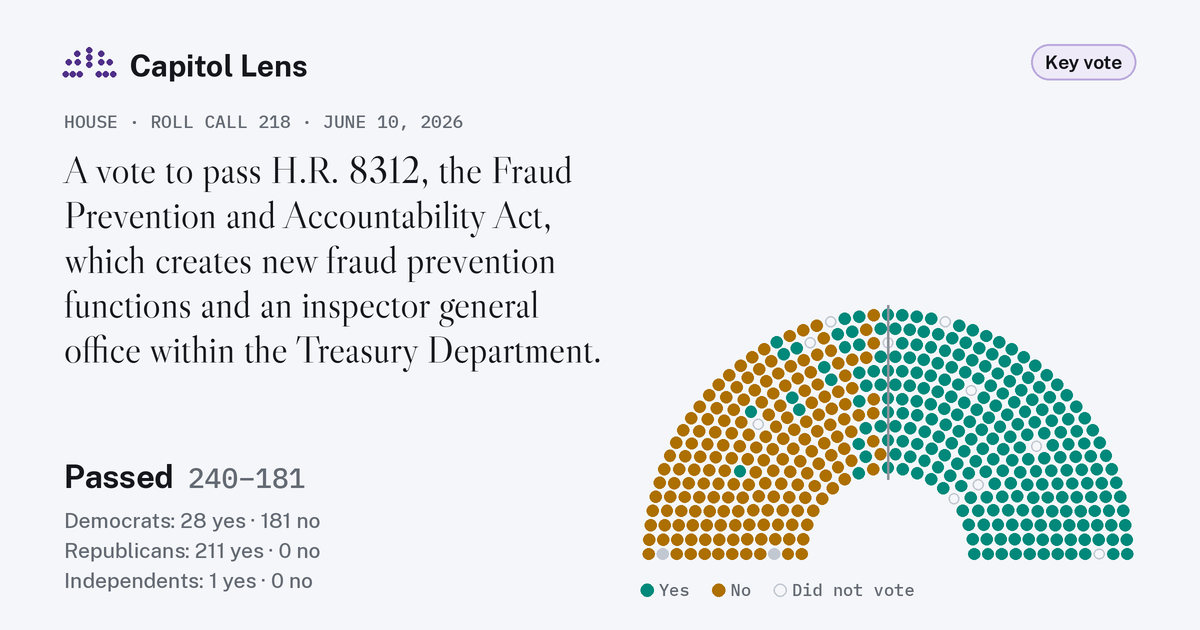
Fraud Prevention and Accountability Act (H.R. 8312) · House · Roll call 218 · 2nd session · June 10, 2026 A vote to pass H.R. 8312, the Fraud Prevention and Accountability Act, which creates new fraud prevention functions and an inspector general office within the Treasury Department.
Why it matters: H.R. 8312 gives the Treasury's Bureau of the Fiscal Service duties on improper payments and spending transparency, creates a Treasury inspector general office for fraud, and requires data-sharing agreements to prevent fraud. Drafted and checked with AI
How did your own members vote? Find them by address or ZIP code
- Question
- On Passage
- Official record
- House roll call 218, 119th Congress, 2nd session
- Capitol Lens ID
- h578, used in this page's address. It numbers every House roll call of the 119th Congress in order, so it differs from the official number, which restarts each session.
- Bill
- H.R. 8312, Fraud Prevention and Accountability Act
How each party voted
Most Democrats voted No (181 of 212).
Most Republicans voted Yes (211 of 218).
Party-line vote: most Democrats and most Republicans voted on opposite sides.
About this vote
The bill gives the Treasury's Bureau of the Fiscal Service duties on financial integrity, preventing improper payments, and spending transparency; creates an Office of the Inspector General for Fraud, Accountability, and Recovery within Treasury; and requires data-sharing agreements to prevent fraud and improper payments. Passage sends the bill to the Senate.
This summary was drafted and checked with AI (Claude) using only the official record of the vote. Report an error
Summary by the Congressional Research Service
Fraud Prevention and Accountability Act This bill (1) assigns financial integrity, improper payment prevention, and spending transparency functions to the Bureau of the Fiscal Service (BFS) within the Department of the Treasury; (2) establishes an Office of the Inspector General for Fraud, Accountability, and Recovery (OIGFAR) within Treasury; and (3) requires Treasury to enter into data sharing agreements with other federal agencies and allowable private entities to prevent fraud and improper payments.